How Does the 101domus Trade Program Work for Interior Designers?
The 101domus trade program gives interior designers and architects professional access to more than 100 selected Italian manufacturers through one platform. Designers apply with their practice profile, work with trade-only pricing and professional conditions, and deal with one personal advisor who coordinates quotes, custom production, orders and delivery across several brands.
By 101domus Editorial Team · Published November 2026

Italian furniture is made by specialist workshops, and a high-end interior is rarely the work of just one. A designer who specifies a sofa from one maker, lighting from a second and a marble table from a third normally ends up with three negotiations, three sets of terms and three shipments. The 101domus framework for interior designers is built to remove that fragmentation: structured access to Italian manufacturers for luxury residential and hospitality projects, with technical, commercial and logistical alignment in one place. This guide explains step by step how the program works, what a designer receives, and when to involve the team, using installations documented in the Projects area.
Why Is Sourcing Italian Furniture Complicated for Independent Designers?
Every Italian maker has its own sales channel, price list, production logic and export routine. For a designer working across borders, the difficulty is rarely taste. It is finding the right workshop for each category, checking that it can adapt dimensions or finishes, and tracking several quotes and shipments while the client waits for one coherent schedule. On a complex project, hours that belong to design go into coordination.
The 101domus pages for professionals describe the answer in three lines: no fragmented contacts, no unnecessary intermediaries, one qualified point of access. In practice a designer registers once, reaches a network of manufacturers selected for quality and production expertise, and works with a single interlocutor even when a project mixes brands, categories and countries. The same structure sits behind more than 100 Italian manufacturers listed on the platform.
How Does the 101domus Trade Program Work, Step by Step?
The process has three public steps. A designer requests professional access by submitting a profile, which opens the network of Italian manufacturers. The designer then connects with selected producers experienced in custom and bespoke production. Finally, tailored solutions are developed through one qualified interlocutor, from concept to production. The registration form asks for name, country, website, the e-mail address to be used to activate the account, a phone number and the type of practice: freelancer or independent professional, team or design studio, large studio or company.
Once access is active, a project follows the same path as any other 101domus project: technical alignment on specifications and drawings, consolidated purchasing, monitored production and coordinated delivery. The sequence below summarises it; the table in the next section compares it with sourcing supplier by supplier.
What Does a Designer Gain Compared With Sourcing Supplier by Supplier?
Access matters only if it changes how a project is run. The table sets the usual way of sourcing, maker by maker, against the model described on the 101domus pages for designers. It describes a method; the terms of each project are agreed at offer stage.


| Aspect | Supplier by supplier | 101domus trade program |
|---|---|---|
| Access to makers | Separate contacts, found and qualified one by one | Direct access to more than 100 selected Italian manufacturers through one platform |
| Pricing | Quotes and conditions negotiated with each maker | Trade-only pricing and professional-only conditions for registered designers |
| Custom work | Feasibility checked separately with each workshop | Semi-custom and bespoke production as a standard, developed directly with manufacturers |
| Technical alignment | Drawings, finishes and samples followed up by the designer | Support with specifications, finishes, dimensional variations, shop drawings and sample coordination |
| Orders and payments | Several orders, contracts and payment schedules | Quotes and orders on one platform; one contractual interface and staged payments on multi-brand projects |
| Logistics | Separate shipments and export paperwork per maker | Consolidated delivery, production monitoring and export documentation aligned with milestones |
| Support | The designer coordinates everyone | A personal advisor guides brand selection, order management and supplier coordination |
Two points deserve precision. First, trade-only pricing is a condition reserved for professionals: the public pages do not publish percentages or discount levels, and designers register to access the structured professional conditions, so none should be expected on the website. Second, the design intent and the client relationship remain with the designer; the program supports specification, production and delivery around them.
Which Tools Does a Registered Designer Use: Wishlists, Project Folders and 3D Models?
Beyond sourcing, the platform carries practical tools for designers, described in the 101domus guide. The My Wishlist / My Projects feature lets a designer save products, create personal folders, add comments and share ready-made selections with clients and colleagues, which turns a client brief into an organised set of project folders.
Product pages list technical specifications, materials, production times and, for many products, 3D models. Where models exist, a 3D MODEL: Download link in the Technical Specifications section opens the files, offered in formats such as .3ds, .obj, .fbx and .skp, with textures included when available and models scaled to real proportions, for use in SketchUp, 3ds Max, Rhino, Blender and similar software. Requests for custom finishes or sizes, with a personalised cost estimate, start from the product page.
Which Kinds of Projects Does the Program Support?

Private residences and country estates
One point of contact for living, dining, bedroom and outdoor pieces from different makers; the purchasing side is covered in Italian furniture procurement for luxury residential projects. Le Mounstier, a country estate in Provence, shows the outdoor side: the Canopo collection by Samuele Mazza for DFN was specified for a 500 m² formal garden in a hot, dry climate.

Hotels and resorts
Hospitality scopes mix many categories that must be ready together. At Pura Vita Beach Resort in Sicily, DFN supplied 48 oversized cabanas with king-size beds and 19 twin sunbeds, in natural chestnut wood. The process from the developer's side is covered in Italian furniture for hospitality projects.

Restaurants, cafés and beach clubs
The Sushisamba Beach Club in Doha has five free-standing lantern cabanas up to five metres high, with structure, lighting and furniture engineered together. At the Orangerie in Katara Village, DFN followed an iron-and-glass structure, façades, flooring and wrought-iron furniture from concept drawings to installation.
Offices and institutional interiors
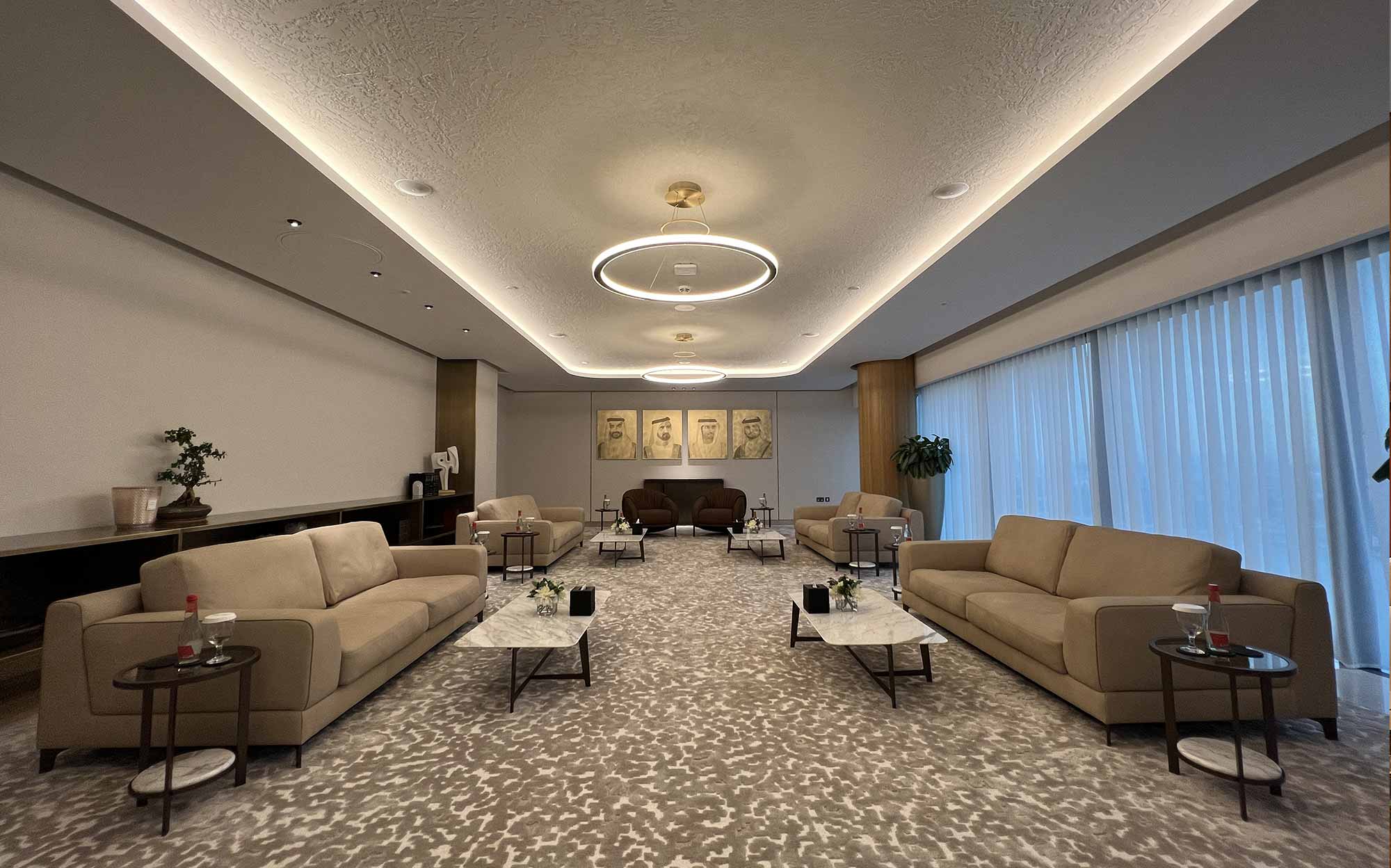
The Dubai Chambers project used Borzalino seating and coffee tables for majlis lounges, executive salons and meeting rooms. Standard collection pieces and custom versions worked together, the same logic designers apply in every typology.
How Are Custom and Bespoke Pieces Developed With a Designer?

Custom work is the standard of this model, not the exception. The manufacturers handle semi-custom changes to dimensions, materials and finishes as well as fully bespoke production, always based on the technical specifications the designer provides. Drawings come first: designer and manufacturer align the executive drawings, and production is released only after they are reviewed and consolidated. Support extends to specifications, finishes, dimensional variations, shop drawings and sample coordination, as described on the page for custom and bespoke production.
The Dubai Chambers Refurbishment shows a typical request. Borzalino made the Ben sofas in a custom version with a 57 cm seat depth, a small dimensional change of the kind designers ask for every day. The practical rule is to send dimensions, finishes and quantities at the start, and to agree maintenance and spare parts with the manufacturer before the order, not after handover.
How Are Delivery and Logistics Handled for International Projects?
Logistics sits inside the same structure. 101domus consolidates shipments from several Italian manufacturers and prepares coordinated export batches, with export documentation and regulatory alignment managed centrally. Delivery is planned against project milestones and site readiness, to destinations that include the Middle East, North America, Asia and Europe. Payments follow the same logic, staged against milestones and available in multiple currencies. The full process is described under international luxury logistics.
For a designer the benefit is concrete. A client who orders a living room from one maker, lighting from another and a table from a third receives one organised delivery instead of three, and the designer has one party to ask about status. The Gulf is a priority region: 101domus is a partner of INDEX Dubai and official media partner of INDEX Saudi Arabia 2026, as reported in 101domus expands its presence in the Middle East and 101domus official media partner of INDEX Saudi Arabia 2026.

When Should a Designer Involve 101domus in a Project?
Designers can either register to access professional conditions or submit an active project for coordination review; both routes are on the interior designer page. Earlier is easier, because feasibility and cost are still open questions. The commercial logic of the wider trade channel is explained in how trade and wholesale work for Italian luxury furniture brands, and the full set of services in the overview of professional project solutions. For hotels and resorts, our guide to Italian furniture for hospitality projects follows the same process from the developer side. For the product side, our guide to classic luxury furniture brands is a useful companion, and a separate page lists international luxury interior designers in the 101domus network.
Frequently Asked Questions About the 101domus Trade Program
Who can join the 101domus trade program?
The program is aimed at interior designers and architects working on high-end projects. The registration form lists three types of practice: freelancer or independent professional, team or design studio, and large studio or company. It asks for name, country, website, the e-mail to activate the account and a phone number.
Can I share product selections with clients and download 3D models?
Yes. The My Wishlist / My Projects feature saves products into personal folders with comments and lets designers share selections with clients and colleagues, and 3D models are available for many products in formats such as .3ds, .obj, .fbx and .skp. Both are explained in the platform guide.
What does trade-only pricing mean in practice?
The site states that registered designers get professional-only conditions across the network of more than 100 Italian brands. Percentages and discount levels are not published on the public pages, so ask for the structured professional conditions when you register.
Can I specify several brands in one project and keep one contact?
Yes. The model is built around one qualified interlocutor and a personal advisor, even when a project combines brands, categories and countries. On multi-brand projects, a single contractual interface and staged payments apply, as described under One Single Partner.
Can pieces be customised for my project?
Yes. Semi-custom and bespoke production is a standard of the platform, developed directly with the manufacturers on the basis of the technical specifications of the project. Drawings are reviewed and consolidated before production is released.
When is the right moment to involve 101domus?
At concept stage, during FF&E specification or at procurement, when feasibility and cost can still be verified; production authorisation is also covered, with supplier scheduling aligned to delivery milestones. A designer can also submit an active project brief for coordination review.
Request professional access to the 101domus network of Italian manufacturers.
Request professional accessEXPLORE 101DOMUS